Choosing plastic shipping boxes for international supply chains is not just a matter of picking the toughest-looking container. The right choice depends on product dimensions, load weight, stacking needs, handling conditions, and how often the box will be reused. A lid that fits neatly on a warehouse shelf may still loosen during a long, bumpy journey. Small details matter.
Architect and circular-design advocate William McDonough is known for the principle, “Waste equals food.” It offers a useful lens for evaluating reusable packaging: consider what happens to the box after delivery, not only how it performs on the outbound trip. For global buyers, that means checking whether the box can be cleaned, repaired, nested, returned, or recycled through available local systems. “The details matter.” A resin label alone cannot guarantee real-world recovery.
This guide compares leading plastic shipping boxes by durability, design, customization, and practical value. It also looks at stackability, closures, empty-box storage, and compatibility with pallets and handling equipment. Specifications can be helpful, but they do not tell the whole story. A box that performs well in one route or climate may disappoint on another. Buyers should request samples and test them with representative products and handling conditions before committing to large orders. No shortlist can replace that step. That is an inconvenient gap, but an important one. The goal is a dependable choice, not a perfect-sounding specification sheet.
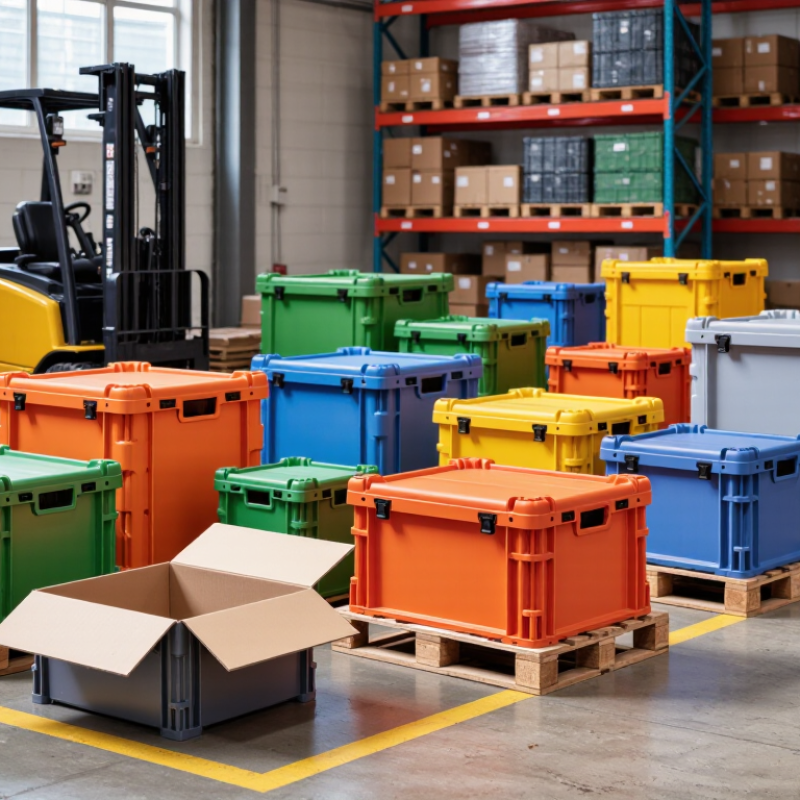
HDPE boxes are valued for impact resistance and dependable performance in demanding handling. They can suit cold-storage routes, though exact performance depends on the grade and design. Polypropylene boxes are often lighter and stiffer, making them useful for reusable crates and folding containers. Yet PP grades can behave differently in low temperatures. Check the maker’s material data before choosing.
Common formats include solid-wall boxes for loose parts, ventilated crates for airflow, and collapsible boxes that save return-shipping space. Measure the product, padding, and pallet footprint together. A box that fits the item may still waste space on a mixed pallet. Fit matters. Also compare lid security, handholds, stacking alignment, and empty-box storage. A small design detail can affect daily handling.
Tips: Request sample boxes and test them with your actual load. Check stacking stability, closure strength, and damage after repeated handling. Ask for load ratings and temperature guidance in writing. Do not assume every “heavy-duty” box performs alike. Packaging decisions can be imperfect; review them after a real shipping cycle.
ASTM D7611 resin identification code 2 indicates HDPE; code 5 indicates PP. These marks identify a resin family, not a box’s grade, recycled content, or shipping performance. HDPE often suits reusable boxes exposed to knocks, moisture, and many common chemicals. PP is typically lighter and can provide good stiffness and heat resistance. Actual performance depends on wall thickness, additives, hinges, and molding quality.
For global shipments, compare boxes under the conditions they will face. HDPE may retain impact performance better in cold environments, while some PP grades can become brittle; confirm this with product-specific test data. Check stacking strength, closure security, and drop-test results with your intended load. A resin code alone is not enough. I would avoid selecting by code alone, even when a box looks sturdy in a sample inspection.
Tips: Ask suppliers for the technical data sheet and temperature range. Test a loaded box on a representative route, including rough handling. Small details matter: a weak hinge can fail before the main wall.
Compare the two common resin options by application and operating conditions. The better choice depends on the box design, load, handling environment, and destination requirements.
| Comparison Factor | Code 2 — HDPE (High-Density Polyethylene) | Code 5 — PP (Polypropylene) | Buyer Guidance |
|---|---|---|---|
| Resin identification | ASTM D7611 resin identification code 2 identifies HDPE. | ASTM D7611 resin identification code 5 identifies PP. | The code identifies the resin type; it does not certify package performance or guarantee that a box is accepted for recycling in every location. |
| Typical material characteristics | Tough, moisture-resistant thermoplastic commonly used in rigid containers and reusable packaging. | Lightweight, moisture-resistant thermoplastic commonly used in rigid packaging and components requiring repeated flexing. | Compare the finished box design, including wall thickness, ribs, hinges, closures, and reinforcement—not resin name alone. |
| Impact and handling | Often selected where toughness and impact resistance are priorities, including demanding handling conditions. | Can perform well in rigid, lightweight designs; impact behavior depends on grade, design, and temperature. | Request testing on the finished box if parcels will be dropped, stacked, or handled repeatedly. |
| Cold conditions | Often a suitable candidate for cold-weather handling because HDPE grades can retain useful toughness at low temperatures. | Some PP grades can become less impact-tough in cold conditions; performance varies by grade and box design. | For cold-chain or winter routes, confirm the supplier’s temperature-specific impact test results for the actual box. |
| Heat exposure | Suitable limits depend on the grade, load, exposure time, and box geometry. | PP generally offers higher heat resistance than HDPE, although the usable limit depends on grade, load, and exposure time. | Check expected warehouse, container, and transit temperatures, and obtain the resin grade’s technical data sheet. |
| Moisture and cleaning | Both materials resist water; HDPE is widely used in products that need moisture-resistant construction. | Both materials resist water; PP is also used for reusable packaging and components that may be cleaned. | Water resistance does not establish chemical compatibility, watertightness, or suitability for a specific cleaning process. Verify these separately. |
| Repeated use and flexing | Can suit reusable applications; service life depends on design, handling, and exposure. | Often considered for components that flex repeatedly, such as living hinges, when designed with an appropriate PP grade. | For returnable shipping, test closure cycles, hinge fatigue, stacking strength, and wear over the intended service life. |
| Potential shipping-box uses | Reusable transit boxes, rigid protective cases, and boxes where toughness is a key design objective. | Lightweight rigid boxes and designs that use PP’s stiffness or flex characteristics, subject to grade and design validation. | Use these as starting points, not universal recommendations. The payload, route, and packaging system determine suitability. |
| Key trade-offs | May not be the preferred option where higher heat resistance or a PP-specific flexing feature is required. | May require extra care in cold-impact applications, depending on grade and design. | Neither resin is automatically the strongest, lightest, or lowest-cost choice in every box design. Compare like-for-like samples and specifications. |
| Global sourcing checks | Ask for the resin grade, recycled-content details if applicable, technical data sheet, dimensions, tare weight, load limits, and relevant test reports. Confirm labeling and end-of-life requirements for destination markets. | For international transport, assess the complete packaging system and applicable shipping, product-safety, and destination-market requirements. | |
Note: ASTM D7611 resin identification codes indicate the type of plastic resin. They are not performance ratings, food-contact approvals, or a guarantee of local recyclability. Actual performance varies by resin grade, additives, manufacturing process, and box design.
For a plastic shipping box, payload is more than the product’s weight. Include dividers, moisture, and movement during handling. A 12-kilogram load may need stronger walls if contents sit unevenly or the box travels far. Test the real load. ASTM D642 provides a recognized method for measuring compressive strength, but lab results should match actual stacking time and conditions.
One weakness in many specifications: they state payload but omit how long boxes remain stacked. Wall thickness alone does not guarantee strength. Rib layout, corner geometry, and plastic type also affect performance. Check stackability with loaded boxes; a lid that flexes can transfer weight onto fragile contents.
Closures need to stay secure through vibration, yet open without damaging the box. Try the chosen latch with gloves and repeat opening and closing. Small details matter.
The U.S. EPA’s 2018 Advancing Sustainable Materials Management report counted 82.2 million tons of containers and packaging in U.S. municipal solid waste. That figure covers many packaging types, not plastic shipping boxes alone, but it reinforces the value of avoiding unnecessary material.
Compare samples under the same payload, stacking height, and handling conditions before specifying a wall thickness. A slightly lighter design may work; it may also fail after a long, warm transit.
For global buyers, transport durability should be measured, not guessed. ASTM D5276 evaluates loaded containers through free-fall drops, while ISO 2248 covers vertical impact testing of complete, filled transport packages. Both help reveal how a plastic shipping box and its contents respond to sudden impact. They are related methods, but results should not be treated as interchangeable without checking the test setup.
Choose boxes representative of production, then record their dimensions, mass, closure method, and contents or equivalent test load. Follow the applicable standard’s specified drop height, impact orientation, surface, and conditioning. Test corners, edges, and faces where required. Small details matter. A loose lid or uneven load can change the result.
After each drop, inspect for cracks, split corners, lid release, permanent deformation, and movement or damage inside the box. Note the sequence and photograph each failure. A box may rebound and look intact while its contents have shifted. Lab testing cannot recreate every route, handling style, or temperature change, so use results alongside shipment data. That limitation deserves attention.
OECD reported that only about 9% of global plastic waste was recycled in 2019. That figure is a warning, not a promise that a plastic shipping box will be recycled. A box can contain recycled plastic and still be difficult to recover after use. Resin type, color, labels, and local sorting capacity all affect what happens next. Small details matter.
When comparing shipping boxes, ask for the recycled-content percentage and supporting documentation. Distinguish post-consumer from pre-consumer content; the terms describe different waste streams. Check whether the box uses one identifiable plastic and whether closures or sleeves are easy to remove. In a packing area, sticky labels and mixed-material add-ons can turn a tidy box into a sorting problem. Labels are not enough.
End-of-life claims should reflect destination markets. A technically recyclable design may not be accepted by local collection systems, and available routes can change. Reuse may reduce demand for new material when boxes survive repeated trips, but weight, cleaning, and return logistics also count. Recycled content is not a complete sustainability score. The uncomfortable part: data can be incomplete, so buyers may need to compare estimates rather than rely on neat, universal answers.