Choosing among the Top 10 Thermal Label Sticker Manufacturers Worldwide requires more than comparing prices or factory photographs. A reliable supplier must deliver readable barcodes, consistent adhesive performance, accurate die-cutting, and stable roll quality. These details matter when labels face warehouse dust, refrigerated storage, sunlight, or repeated handling.
This guide evaluates manufacturers through practical purchasing criteria, including material selection, printing technology, production capacity, quality control, customization, certifications, and customer support. It considers common formats, such as 4 × 6 shipping labels, retail price stickers, inventory tags, and small product labels. Direct thermal materials suit short-term applications, while thermal transfer options often provide stronger resistance against heat, moisture, and abrasion. Buyers should also inspect core size, winding direction, roll length, liner strength, and adhesive compatibility before placing large orders.
Real-world experience can reveal weaknesses that brochures hide. A sample roll may feed smoothly, yet a full pallet could show curling or uneven coating. It happens. Therefore, this overview treats supplier reputation as important, but not conclusive. Rankings may change as factories improve equipment, expand certifications, or lose consistency. Testing remains essential.
The selected companies are discussed with a balanced view of their capabilities, market reach, and potential limitations. Readers will find practical questions for comparing quotations, requesting samples, and verifying production claims. The goal is not to promote one universal winner. Different businesses need different label solutions, budgets, and delivery arrangements. Reliable evidence matters more than impressive promises.
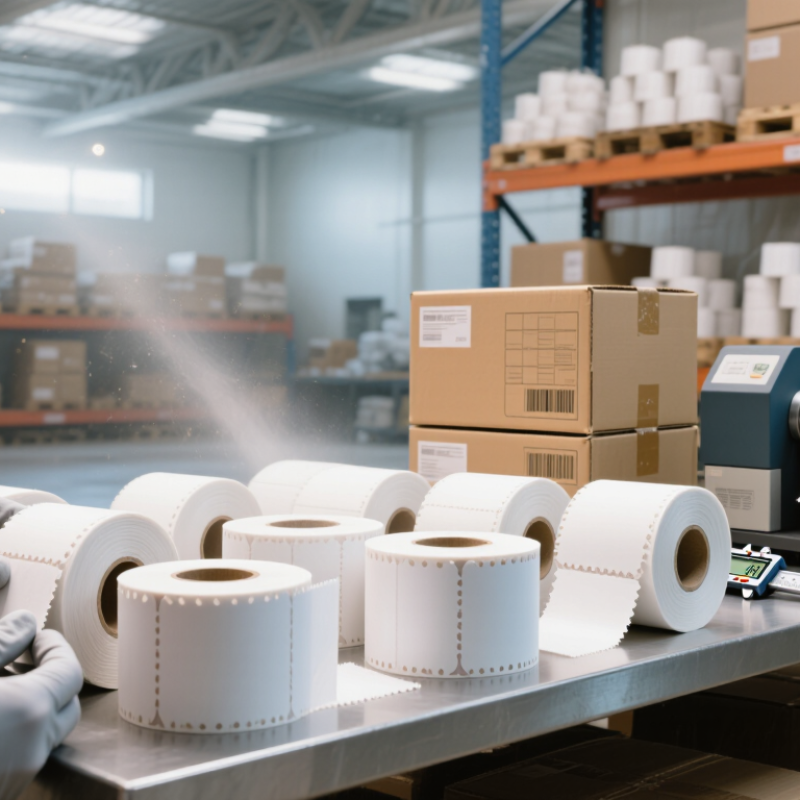
Thermal label stickers are pressure-sensitive labels printed by heat rather than ordinary inkjet or laser methods. In direct thermal printing, a heated printhead darkens a coating on the label surface. No ribbon is needed. The process suits shipping labels, receipts, and short-term inventory tags, but heat, sunlight, and friction can fade the image. Thermal transfer printing works differently: the printhead melts ink from a ribbon onto the label, producing marks that generally last longer. The right choice depends on storage conditions, handling, and the required lifespan.
The details matter. A damp parcel, a warm warehouse, or a rough conveyor can affect readability, so material and adhesive selection should match the job. Smithers’ report, The Future of Thermal Paper to 2028, tracks continued demand for thermal paper across applications including labels and receipts; however, market growth alone does not show which label will perform best in a specific workflow.
Test a sample with the actual printer, barcode, and packaging. Small mistakes show up fast.
Also check barcode print quality against ISO/IEC 15416, a standard referenced in GS1 guidance. A clean-looking label is not always a reliably scannable one.
Choosing a thermal label supplier takes more than comparing quoted prices. Smithers’ The Future of Label Printing to 2028 projects continued growth in global label demand, making consistent production capacity and quality controls important. Ask manufacturers for sample rolls, production tolerances, and documented inspection procedures. Check whether the adhesive suits your actual surface, such as a chilled carton or a dusty warehouse bin. Test labels with your own printer and scanners; a clean sample alone proves little. For barcode verification, request results against ISO/IEC 15416, which defines a print-quality grading method. Also review roll winding, core dimensions, and packaging, since small mismatches can interrupt a busy labeling line.
Tips: Run a trial on the real substrate. Record scan grades before and after exposure to expected heat, moisture, or handling. Ask for the test conditions, not just a pass mark.
Compare suppliers using the same checklist. Include lead times, batch traceability, defect handling, and the availability of direct-thermal and thermal-transfer options. FINAT’s technical test methods offer useful reference procedures for label performance, but results depend on test conditions and should not replace application-specific trials. Request recent test records and clarify how changes in facestock, coating, or adhesive are communicated. One oversight is easy to make: a label can look sharp at dispatch, then fade under light or friction. Ask what the manufacturer has verified—and what remains untested.
Thermal label sticker manufacturers differ in coating control, adhesive selection, and converting capacity. These ten profiles describe common supplier types worldwide without naming individual companies. High-volume converters focus on consistent rolls for shipping and retail. Custom die-cut specialists handle unusual shapes and smaller orders. Direct thermal producers serve short-lived labels, while thermal-transfer specialists supply materials designed for ribbon printing. Food and logistics suppliers prioritize readable barcodes and dependable adhesion. Synthetic-label makers target moisture, rubbing, and tougher handling.
Other profiles include regional converters with shorter lead times, integrated producers that manage paper coating and finishing, export-focused factories with broad format options, and service-led suppliers offering sample rolls and print guidance. Paper matters, too. A capable supplier should explain face stock, adhesive, liner, core size, and storage conditions in plain terms. Ask for samples, then test them on the intended printer and packaging surface. Check barcode clarity, edge lift, and performance after handling. A polished specification sheet is useful, but it cannot replace a real print trial. Not every manufacturer excels at every material or order size, and that is worth checking before purchase.
Illustrative regional profiles, not a verified ranking or company-specific directory. Product ranges and capabilities vary by manufacturer; confirm specifications, compliance, and certifications directly with suppliers.
| No. | Manufacturing Region | Representative Manufacturer Profile | Common Product Formats | Printing Compatibility | Typical Applications | Key Sourcing Considerations |
|---|---|---|---|---|---|---|
| 1 | East China | High-volume producer serving domestic and export markets, often offering multiple paper grades and roll sizes. | Direct thermal rolls, fanfold labels, and custom-size converted rolls. | Primarily direct thermal; thermal-transfer stock may also be available. | E-commerce shipping, retail checkout, and warehouse identification. | Check roll dimensions, core size, adhesive performance, and sample consistency before placing large orders. |
| 2 | South China | Converter-oriented producer with flexible finishing options and a focus on export-ready packaging. | Small-format labels, barcode rolls, fanfold stock, and custom die-cut labels. | Direct thermal and thermal-transfer options, subject to product specification. | Parcel labeling, electronics packaging, and product identification. | Confirm die-cut tolerances, packaging method, lead time, and the intended printer’s media requirements. |
| 3 | United States | Regional producer or converter supplying standard and application-specific label materials to business customers. | Roll labels, fanfold labels, blank labels, and selected custom constructions. | Direct thermal and thermal-transfer stocks are commonly specified for different durability needs. | Retail, shipping, healthcare, and inventory operations. | Specify printer model, label dimensions, core and roll limits, and any required regulatory documentation. |
| 4 | Canada | North American supplier profile focused on converting label stock for local distribution and commercial users. | Shipping labels, warehouse rolls, and selected custom-size formats. | Most commonly direct thermal for short-life labels; thermal-transfer options depend on the range. | Logistics, retail, manufacturing, and stock management. | Check cold-temperature adhesion where relevant and confirm bilingual or other labeling requirements for the application. |
| 5 | Germany and Central Europe | Technical-label supplier profile serving industrial users and customers with defined material specifications. | Paper and synthetic labels, roll formats, and application-specific constructions. | Thermal-transfer is often selected for durable identification; direct thermal is used where suitable. | Industrial identification, logistics, and product labeling. | Request technical data for face stock, adhesive, liner, print method, and tested environmental conditions. |
| 6 | Italy and Southern Europe | Label converter profile combining standard thermal products with customized sizes or adhesive options. | Retail rolls, product labels, custom die-cut formats, and selected synthetic labels. | Direct thermal and thermal-transfer constructions, depending on the required print life. | Food and beverage packaging, retail, and distribution labeling. | For regulated uses, verify that the exact label construction is suitable for the intended contact and storage conditions. |
| 7 | United Kingdom | Local supply and converting profile supporting standard business labeling and short-run requirements. | Shipping rolls, retail labels, and custom-width converted rolls. | Direct thermal is common for transient labels; thermal-transfer stock is available in many product ranges. | Parcel delivery, retail, and warehouse operations. | Confirm compatibility with local printer settings, roll direction, core size, and delivery requirements. |
| 8 | Japan | Precision-oriented label supplier profile emphasizing consistent converting and defined product specifications. | Compact roll labels, retail formats, and selected specialty constructions. | Direct thermal and thermal-transfer materials, selected according to printer and use conditions. | Retail, logistics, manufacturing, and product tracking. | Check dimensional tolerances, print quality expectations, and compatibility with the specific printer and ribbon combination. |
| 9 | South Korea | Technology and commerce supply profile serving barcode, retail, and distribution labeling needs. | Barcode rolls, shipping labels, and custom-converted formats. | Direct thermal is widely used for short-term labels; thermal-transfer options depend on the application. | E-commerce, retail, electronics, and inventory control. | Confirm adhesive choice, label orientation, roll specifications, and barcode readability on the intended printer. |
| 10 | India | Growing regional supplier profile supporting domestic commerce, logistics, and industrial identification. | Direct thermal rolls, barcode labels, and selected custom sizes. | Direct thermal is common for shipping and retail; thermal-transfer materials may be offered for longer-lasting labels. | Logistics, retail, pharmaceuticals, and manufacturing. | Evaluate print durability under local heat and humidity conditions, and verify applicable sector-specific requirements. |
Thermal label performance starts with the material, not the printer. Direct thermal paper reacts to heat and suits short-term shipping labels or receipts. It needs no ribbon, which keeps supplies simple. But sunlight, friction, and heat can darken or fade the image. For longer-lasting marks, thermal-transfer printing uses a ribbon to place ink onto the label. It adds a consumable, yet often produces more durable results.
Paper labels are usually economical and work well on clean, dry cartons. Coated paper can improve print clarity, though it may still struggle with moisture. Polypropylene offers better resistance to water and tearing, while polyester is a stronger choice for labels exposed to abrasion or chemicals. The exact adhesive matters too. A label that holds firmly on cardboard may lift from a curved plastic container. Test it. Small details matter.
Product options vary by roll width, core size, winding direction, and perforation. These specifications affect printer compatibility and how quickly staff can apply labels. Some suppliers also offer fanfold stacks for printers designed to accept them. Before comparing manufacturers, request samples and check barcode readability, adhesion, and print consistency under real storage conditions. Specifications help, but they do not tell the whole story. I would not choose a material from a product sheet alone; actual handling can reveal a mismatch.
Thermal label sticker manufacturers serve demanding industries, but their strengths differ. Logistics companies need labels that scan after vibration, dust, and temperature changes. Retail operations often prioritize sharp barcodes, fast production, and consistent adhesive performance. Healthcare facilities require clean printing, traceability, and materials suited to controlled environments. Food producers may need moisture-resistant labels for chilled packaging. Manufacturing sites usually value durability, chemical resistance, and dependable roll dimensions.
Supplier selection should begin with application testing, not attractive catalogs. Check the adhesive on cartons, plastic, glass, and uneven surfaces. Test readability after refrigeration, abrasion, and extended storage. Small details matter. Ask about liner quality, core sizes, coating options, print compatibility, and batch consistency. A reliable manufacturer should provide technical data, sample rolls, inspection procedures, and clear production tolerances. Certifications can support trust, but they should not replace physical testing.
Delivery stability also deserves attention. Review lead times, minimum order quantities, packaging protection, and communication during shortages. Regional support may reduce delays and simplify technical discussions. Cost comparisons should include waste, printer downtime, and rejected scans. No supplier is perfect. I have seen excellent labels fail because the adhesive matched the surface poorly. That lesson stays. A sensible top-ten evaluation should weigh industry experience, documented quality systems, responsive service, and honest limitations, rather than price alone. Test before scaling.